180kg Deadlift to Zercher: A Lift More People Should Be Doing
There are some exercises you do because they're in the programme.
There are others you keep coming back to because they just make sense.
The deadlift to Zercher is firmly in the second category for me.
I've been using these with clients for years, long before Zerchers seemed to become quite as fashionable as they are now. The reason was simple: we realised just how much you get from a single movement.
Recently, Oli hit a 180kg PB at 75kg bodyweight , finally putting away a weight that had proved elusive before.
And it was great to see.
Strength Training and Hemingway
One of the things I enjoy most about personal training is the people I get to spend my working day with.
Oli is a literary professor, which means the rest periods between heavy sets can move fairly seamlessly from talking about lifting to Hemingway, literature and whatever else we've got onto that day.
Then the timer goes off and it's back to picking something horrible off the floor.
Not a bad way to spend an hour.
And over time, I've watched Oli get seriously strong.
The 180kg deadlift to Zercher is a good example of that progress, because this isn't simply a case of being able to deadlift 180kg.
You've got to do considerably more with it.
What Is a Deadlift to Zercher?
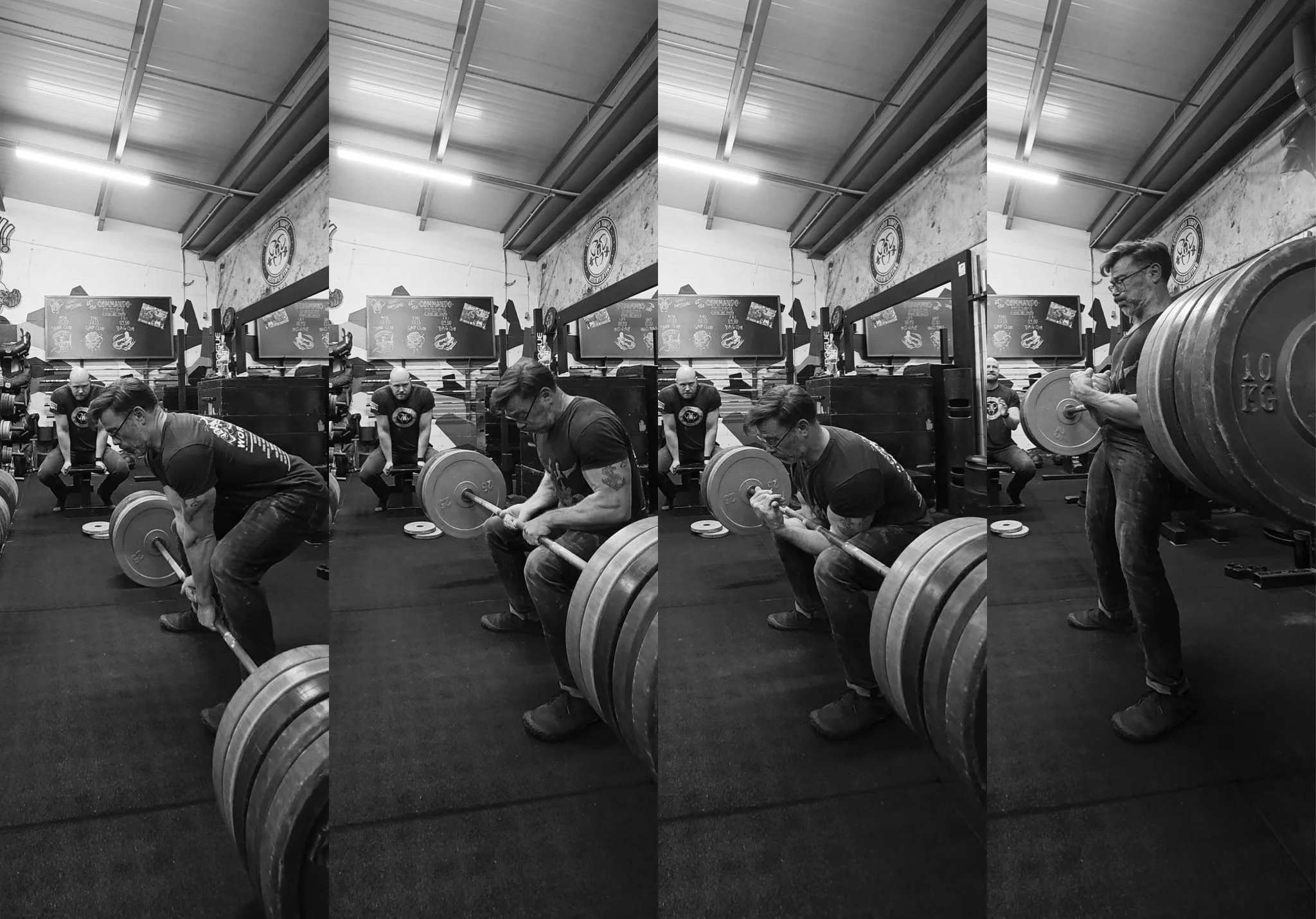
The movement starts exactly where you'd expect.
You deadlift the bar from the floor, before lowering it onto the thighs and getting underneath it. From there, you transfer the bar into the crooks of the elbows — the Zercher position — before standing up with it.
So one rep asks you to:
Pull it. Control it. Lap it. Get underneath it. Stand up with it.
That's why I like it so much.
There's an enormous difference between being strong when everything is perfectly positioned and being able to manipulate a heavy object through different positions.
The deadlift to Zercher trains the latter.
Why Deadlift to Zerchers Are So Good
It develops strength through a huge range
You're working from the floor all the way to a standing Zercher position.
The initial deadlift develops the posterior chain and your ability to produce force from the ground. The transition requires control, positioning and a great deal of tension. The final Zercher squat demands legs, upper back, trunk and the ability to stay braced while a heavy load tries to fold you in half.
It's a lot of strength training packed into one rep.
It builds ridiculous trunk and upper-back strength
Put a genuinely heavy bar in the crooks of your elbows and your body has a fairly straightforward problem to solve:
Don't collapse.
Your abs, obliques, spinal erectors and upper back all have to work incredibly hard to maintain position.
I like that kind of trunk training because you're not just isolating your core. You're asking it to do its actual job while the rest of the body produces force.
It teaches you to deal with awkward weight
This is probably the biggest reason I've kept the movement in my toolbox.
Strength doesn't always happen with a perfectly balanced barbell in the perfect starting position.
A stone isn't like that.
Neither is a sandbag.
Neither is a person, a piece of furniture or most of the genuinely heavy things you might encounter outside a gym.
The deadlift to Zercher teaches you to move around a load, reposition it and continue producing force.
That has huge carryover to the sort of unconventional strength training we do at BearWolf.
Carryover to Stones and Sandbags
If you're interested in natural stone lifting or Strongman-style training, I think the value becomes even more obvious.
When you lift a heavy stone, you don't normally just pull it smoothly from the floor to lockout.
You break it from the ground. You lap it. You reposition yourself. You get your body around it. Then you stand, carry or load it.
Heavy sandbags present a similar problem.
The deadlift to Zercher isn't identical to either of those movements — nor does it need to be.
It develops many of the qualities that make you better at them.
Strength from the floor.
Confidence with a heavy load in front of you.
A strong lap position.
Bracing.
Upper-back strength.
The ability to keep working when the weight isn't conveniently positioned.
For someone like me who spends an unreasonable amount of time picking up stones, that's pretty useful.
More People Should Do Them
You don't need to be a Strongman competitor or natural stone lifter to benefit from them.
They can be scaled.
You can learn the positions with a relatively light bar and gradually build the movement as your strength and confidence improve.
And I think there's something valuable about exercises that require you to actually solve a physical problem, rather than simply moving a weight along the same predetermined path every week.
Done properly, deadlift to Zerchers develop a broad sort of strength.
The kind that transfers.
And they're also just good fun.
Admittedly, my definition of fun may have become slightly distorted after 15+ years of strength coaching.
180kg: Done
For Oli, the important thing wasn't that this is an unusual exercise or that Zerchers seem to be having their moment.
It was getting 180kg.
A weight that had beaten him before.
This time it didn't.
A big PB, a seriously strong lift and a very satisfying bit of progress to watch as his coach.
Want to get stronger?
I offer one-to-one personal training and strength coaching at the Commando Temple in Deptford, London, working with everyone from complete beginners through to experienced lifters.
You don't need to want to deadlift 180kg, lift stones or put barbells in the crooks of your elbows.
But if you do, you're certainly in the right place.